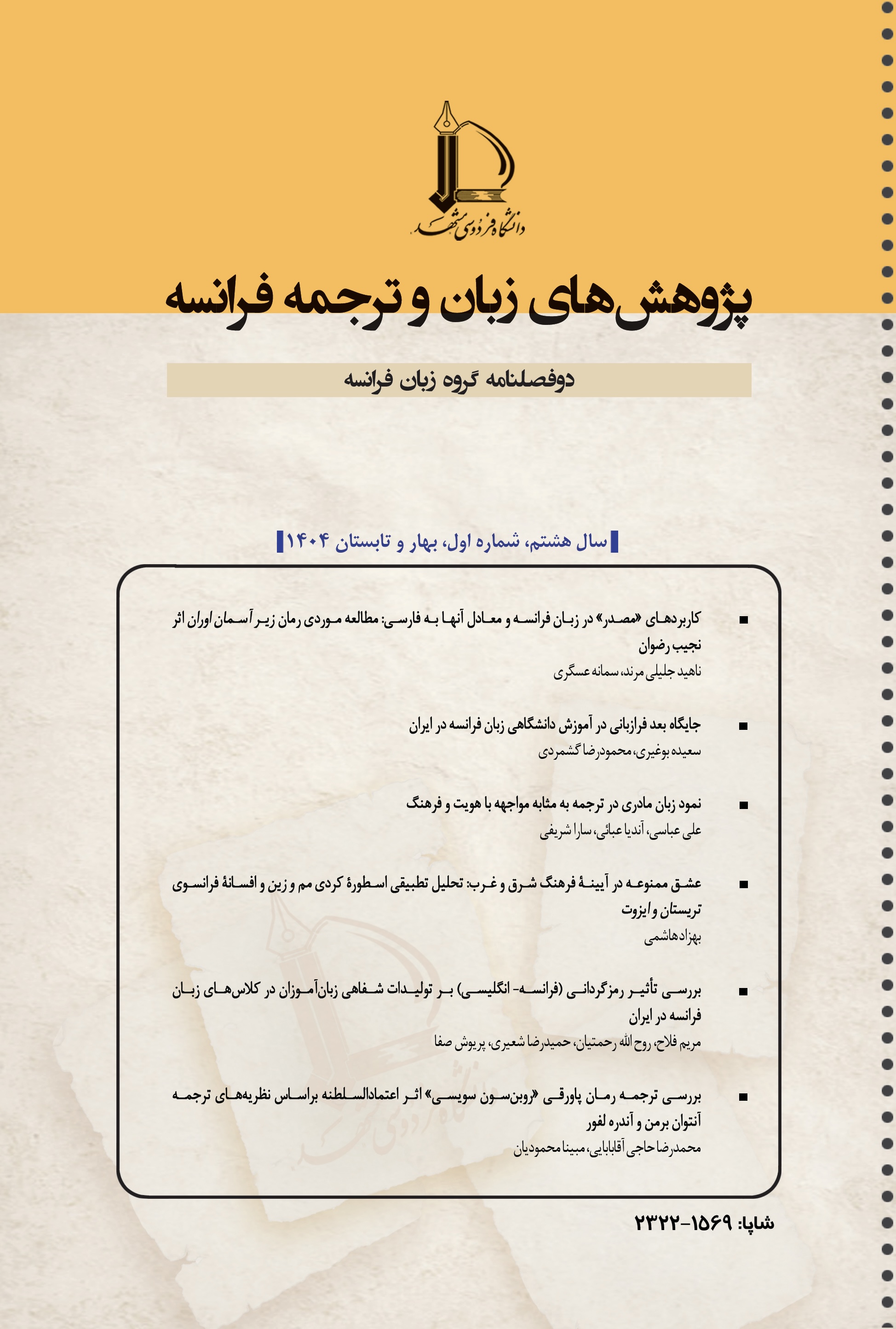
پژوهش های زبان و ترجمه فرانسه

پژوهش های زبان و ترجمه فرانسه

جایگاه بعد فرازبانی در آموزش دانشگاهی زبان فرانسه در ایران

نوع مقاله : مقاله پژوهشی

نویسندگان
1 دانش‌آموخته دکتری آموزش زبان فرانسه، گروه زبان فرانسه، دانشکده علوم انسانی، دانشگاه تربیت مدرس، تهران، ایران.
2 دانشیار گروه آموزش زبان فرانسه، دانشکده علوم انسانی، دانشگاه تربیت مدرس، تهران، ایران.
چکیده
رویدادهای اجتماعی و علمی قرن بیستم به پیدایش رویکردهای نوین آموزش زبان انجامید. متأخرترین این رویکردها سازا‌گرایی اجتماعی است که بسیاری از کلیدواژه‌های آموزش مانند مهارت‌گرایی و حرفه‌ای‌سازی از آن برمی‌آیند. تدوین برنامه درسی بستر تحقق این کلیدواژه‌هاست. در سرفصل کارشناسی رشتۀ زبان فرانسه پیشین مواردی مانند تفوق مطلق جنبه زبانی، فقدان نگاه بینارشته‌ای و لحاظ‌نشدن نیازهای حرفه‌ای دانشجویان قابل مشاهده بود. در سرفصل جدید در این موارد بازنگری گردید. پژوهش حاضر با نگاهی به سرفصل جدید در چارچوب نظریه‌های سازاگرای تاردیف (1997)، آموزش زبان‌-فرهنگ بیاکو (2000) و پورِن (2017) به بررسی جایگاه توانش فرازبانی و مقایسه آن با سرفصل پیشین پرداخته است. در چارچوب این نظریه‌ها، مفهوم فرازبانی در این پژوهش به معنای توانش ارتباطی، حرفه‌ای‌سازی و کسب استقلال در فراگیران خواهد بود. هدف این تحقیق بررسی سرفصل جدید در جهت همگام‌سازی آموزش زبان فرانسه در ایران با رویکردهای نوین آموزشی در دنیا مانند سازاگرایی است. پرسش پژوهش چنین است: پس از بازنگری سرفصل رشته زبان و ادبیات فرانسه، چه تغییری در روال سنتی آموزش مهارت‌های زبانی در رشته زبان فرانسه در ایران ایجاد شده است؟ این پژوهش به روش مقایسه کیفی دروس سرفصل‌ قدیم و جدید انجام گرفت. نتایج مثبت پژوهش عبارتند از: تلفیق گرایش‌های ادبی، ترجمه و آموزش، به‌روزرسانی برنامه با افزودن واحدهای درسی مبتنی بر استفاده از فناوری‌های نوین، راهبردهای یادگیری، لحاظ‌کردن نیازهای حرفه‌ای دانشجویان، تجزیه واحدهای کلان درسی و تبدیل آن‌ها به واحدهای تخصصی‌تر با تکیه بر مهارت‌های تعریف‌شده در چارچوب مرجع مشترک اروپایی. جنبه‌هایی نیز همچنان جای کار دارند: نسبت بالای واحدهای متمرکز بر ادبیات، موازی‌بودن برخی دروس، بلاتکلیفی محتوایی یا گنجاندن زودهنگام برخی دروس در سرفصل کارشناسی و لحاظ‌نشدن واحد درسی جداگانه‌ای برای آشنایی با چارچوب مرجع مشترک اروپایی به عنوان معیار اصلی تدوین روش­های آموزش و ارزشیابی آزمون‌های بین‌المللی زبان.
کلیدواژه‌ها
موضوعات

عنوان مقاله English

The Place of Metalinguistic Aspects in University Teaching of French in Iran

نویسندگان English

Saideh Bogheiri 1
Mahmoud Reza Gashmardi 2
1 The Place of Metalinguistic Aspects in University Teaching of French in Iran.
2 Associate Professor, Department of French Language Education, Faculty of Humans Sciences, Tarbiat Modares University, Tehran, Iran.
چکیده English

The social and scientific developments of the 20th century led to the emergence of new approaches in language teaching. The revised curriculum addresses these issues. In this study, drawing on Tardif’s (1997) constructivist theories, Byram’s (2000) language-culture teaching model, and Puren’s (2017) framework, we examine the role of metalinguistic competence and compare its presence in the old and new curricula. Within these theoretical frameworks, metalinguistic competence is defined as communicative competence, professionalization, and learner autonomy. The aim of this research is to analyze the new curriculum to align French language education in Iran with modern pedagogical approaches, such as constructivism. The research question is: What changes has the revised French language and literature curriculum brought to the traditional approach of teaching language skills in Iran? This study employs a qualitative comparative method to evaluate the old and new curricula. Positive findings include: The integration of literary, translation, and teaching specializations. Curriculum modernization with new courses on technology and learning strategies. Consideration of students' professional needs. The breakdown of broad course units into more specialized modules based on the skills defined in the Common European Framework of Reference for Languages (CEFR). However, some areas still require improvement: A high proportion of literature-focused courses. Overlapping content in certain subjects. Unclear course content or premature inclusion of some subjects in the undergraduate curriculum. The absence of a dedicated course on the CEFR, which is crucial for designing teaching methods and assessing international language certifications.

کلیدواژه‌ها English

Metalinguistic competence
language-culture
social constructivism
Common European Framework of Reference (CEFR)
curriculum
French language teaching
بوغیری، س.، و گشمردی، م. (1401). بررسی جذب اجتماعی در فضای دانشگاهی به عنوان یک عامل موثر بر تاب‌آوری و موفقیت تحصیلی دانشجویان زبان فرانسه در ایران. پژوهش­های زبان و ترجمۀ فرانسه، 5 (8)، صص 135- 157. 
بوغیری، س.، و گشمردی، م. (1401). آموزش ترجمه، چارچوب سنتی یا آموزش مهارت‌محور، همایش بین‌المللی آیندۀ ترجمه ادبی فرانسه-فارسی در ایران، مهرماه 1401، تهران، دانشگاه علامه‌طباطبائی.
خوشکام، پ.، و گشمردی، م.، رحمتیان، ر، صفا، پ. (1403). تأثیر استفاده از راهبردهای آموزش - یادگیری مبتنی بر مغز، بر پیشرفت یادگیری فراگیران بزرگسال زبان فرانسه در ایران. پژوهش­های زبان و ترجمۀ فرانسه، 7 (12)، صص 27- 60.
 
Beacco, J.C. (2013). Articuler les compétences langagières et les compétences culturelles/interculturelles dans l’enseignement des langues. Cultures, discours, langues : nouveaux abordages, Lambert Lucas, p. 165-186., 2013. ⟨hal-01455831⟩, consulté le 6 mai 2025.
Beacco, J.C. (2000). Les dimensions culturelles des enseignements des langues, Paris : Hachette Livre.
Blanchet, p. (2018, Septembre). Quels cadres, quels objectifs et quels critères pour
évaluer une méthodologie d’enseignement-apprentissage des langues ? [Congres Méthodal, Thessalonique].
https://univ-rennes2.hal.science/hal-02518850v1
Canale, M., & Swain, M. (1980). Theoretical bases of communicative approaches to second language teaching and testing. Applied Linguistics 1 (1), 1-47.
Common European Framework of Reference for Languages (2001). Council of Europe.  https://rm.coe.int/16802fc1bf
Cyr, P. (2008), Les strategies d'apprentissage, Paris : CLE International.
Fantini, A., & Tirmizi, A. (2006). Exploring and Assessing Intercultural Competence. World Learning Publications. Paper 1. http://digitalcollections.sit.edu/worldlearning_publications/1
Fantini, A.E. (2000). A Central Concern: Developing Intercultural Competence. SIT Occasional Papers Series (1). School for International Training, pp. 25-42.  https://digitalcollections.sit.edu/cgi/viewcontent.cgi?article=1000&context=sop
Galisson R., et al. (1982). D'autres voies pour la didactique des langues étrangères. Paris : Hatier-Crédif, Coll. LAL.
Hymes, D.H. (1972). On communicative competence. In J.B. Pride & J. Holmes (Eds.), Sociolinguistics (pp. 269–293). London: Penguin.
Lázár, I., & Huber-Kriegler, M., & Lussier, D., & S.Matei, G. (2020). A guide for language teachers and teacher educators Developing and assessing intercultural communicative competence A guide for language teachers and teacher educators. Council of Europe. https://www.researchgate.net/publication/338459125_A_guide_for_language_teachers_and_teacher_educators_Developing_and_assessing_intercultural_communicative_competence_A_guide_for_language_teachers_and_teacher_educators
Lussier, D., & Lázár, I. (2016). Developing and assessing intercultural communicative competence. https://www.researchgate.net/publication/242261272_Developing_and_assessing_intercultural_communicative_competence
LE Boterf, G. (2008). Repenser la compétence pour dépasser les idées reçues : 15 propositions. Paris : Groupe Eyrolles.
Porcher, L., & Abdallah-Pretceille, M. (1996). Éducation et communication interculturelle. PUF - L'Éducateur.
Puren, Ch. (2017), "Mettre en œuvre la pédagogie de projet dans un contexte interdisciplinaire au collège. Approche historique, problématiques actuelles" (Livret des séminaires à l'Université Tarbiat Modares à Téhéran), www.christianpuren.com/mes-travaux/2017c/
Puren, Ch. (2017), "Caractéristiques tendancielles de l'agir en perspective actionnelles" (Livret des ateliers à l'Université Tarbiat Modares à Téhéran), www.christianpuren.com/bibliothèque-de-travail.067/
Puren, Ch. (2017), "Les objectifs d'usage possible de l'apprentissage des langues-cultures étrangères et les méthodologies d'enseignement correspondantes actuellement disponibles" (Livret des ateliers à l'Université Tarbiat Modares à Téhéran),  www.christianpuren.com/bibliothèque-de-travail.052/
Puren, Ch. (2003), Pour une didactique complexe des langues-cultures in Études de Linguistique Appliquée, pp. 121-126. https://www.researchgate.net/publication/337380157, consulté le 8 mai 2025. Tardif, J. & Dubois, B., (2013). « De la nature des compétences transversales jusqu'à leur évaluation : une course à obstacles, souvent infranchissables » in Revue française de linguistique appliquée, 2013/1 Vol. XVIII | pages 29 à 45, ISSN 1386-1204, consulté le 6 mai 25. 
Tardif, J. (1997). Pour un enseignement stratégique. L’apport de la psychologie cognitive. Montréal : Les éditions LOGIQUES.
Van Ek, J. (1986). Objectives for Foreign Language Learning. Strasbourg: Council of Europe.
Véronique, D. (2006). Perspectives en didactique des langues et des cultures. Travaux de didactique du français langue étrangère,55, p. 7-13.
Zarate, G. (1986). Enseigner une culture étrangère. Paris : Hachette.
ارسال نظر در مورد این مقاله
نام را وارد کنید.
نشانی پست الکترونیکی را به درستی وارد کنید.
وابستگی سازمانی را به درستی وارد کنید.
توضیحات را وارد کنید (حداقل 50 حرف)
CAPTCHA Image
شناسه امنیتی را به درستی وارد کنید.

  • تاریخ دریافت 25 اردیبهشت 1404
  • تاریخ بازنگری 01 مرداد 1404
  • تاریخ پذیرش 08 مرداد 1404